In 2017, when I used the Red Deer River and the South Saskatchewan to cross the Prairies, I biked past the portion of the North Saskatchewan that goes to Rocky Mountain House. I didn’t know anything about the river and assumed that because it is in the foothills of the Rockies there would likely be some Class 3 rapids that I prefer to avoid. This year, not wanting to stow the paddle quite yet, I considered doing the North Saskatchewan but was undecided where I should start. In 2017 I pulled the canoe from Tete Jaune Cache, on the B.C. side of the Rockies, to Jasper and then south to the Athabasca Icefields and over Sunwapta Pass to get to beyond Rocky Mountain House. I didn’t want to repeat that trip. I also considered biking from Jasper to Drayton Valley but that would leave out a considerable portion of the river. In 2023 I stored the canoe with Jasper Outdoors and JF, the owner, has an extension slide-out in his pickup that was long enough to haul a canoe right side up in the box. When I asked him for a price to get me over Sunwapta Pass his estimate range was exactly the same as mine.
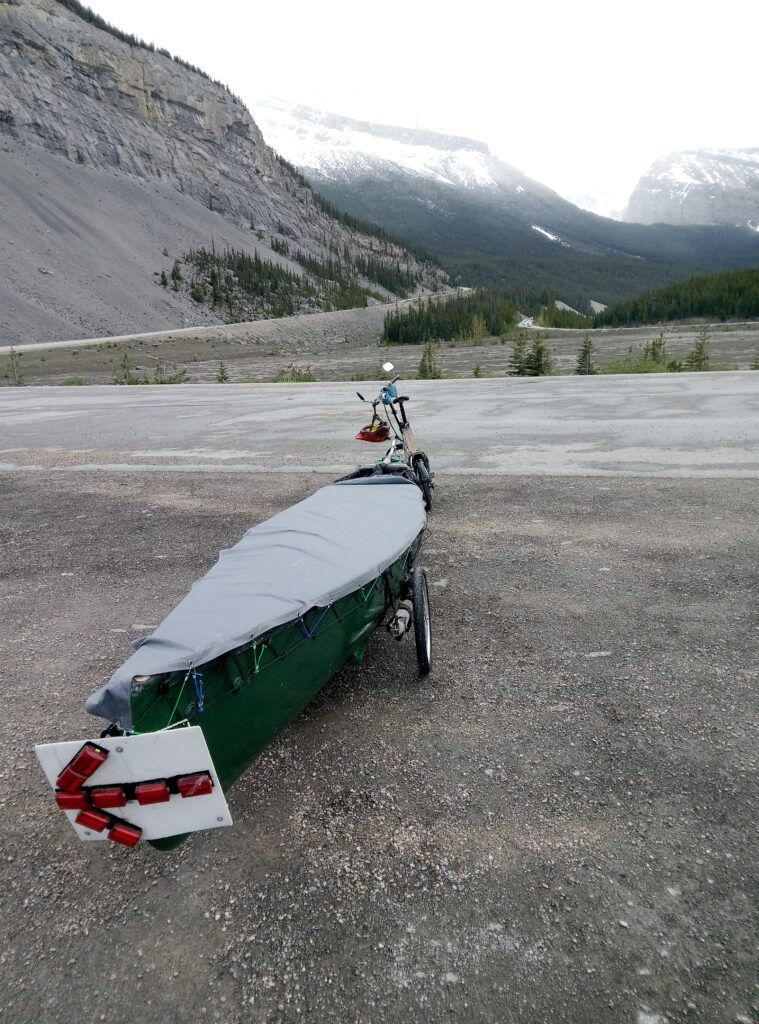
Ready to roll after a 118 kilometre vehicle ride from Jasper. 106 to go to reach my intended put-in place at the Abraham Lake, Big Horn Dam. Thanks to JF of Jasper Outdoors for getting me here. I had only asked to be brought to the summit but there were snowflakes falling on top and he brought me well down the mountainside.
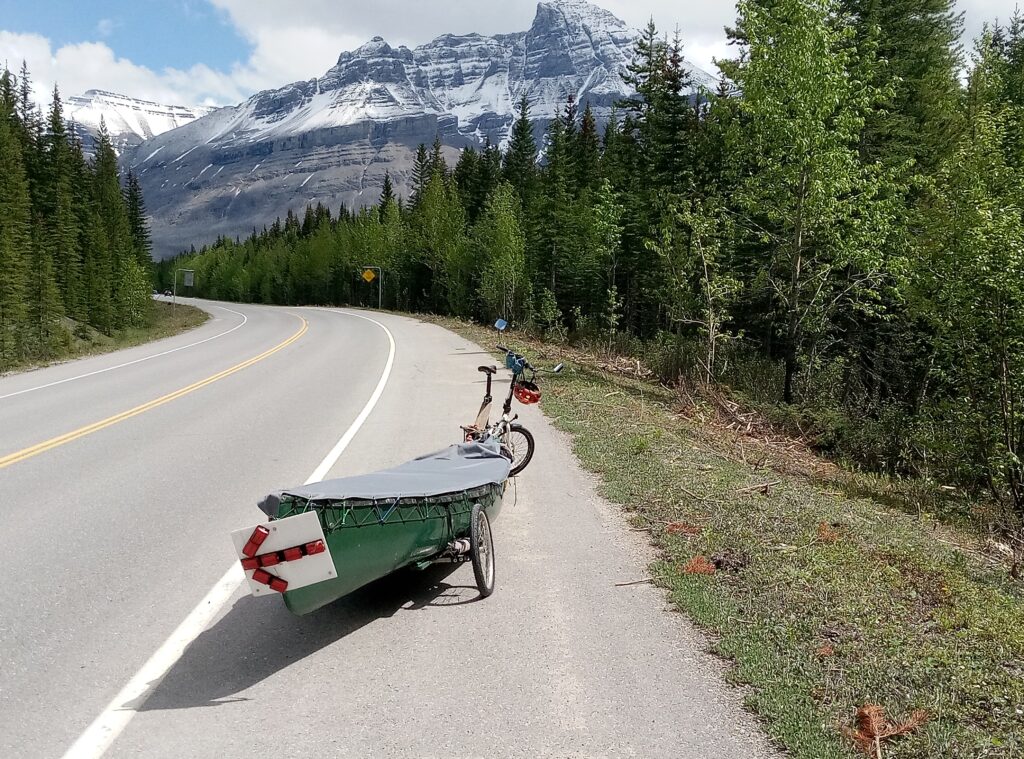
The Banff Jasper highway runs north south through the Rockies. A very scenic route.
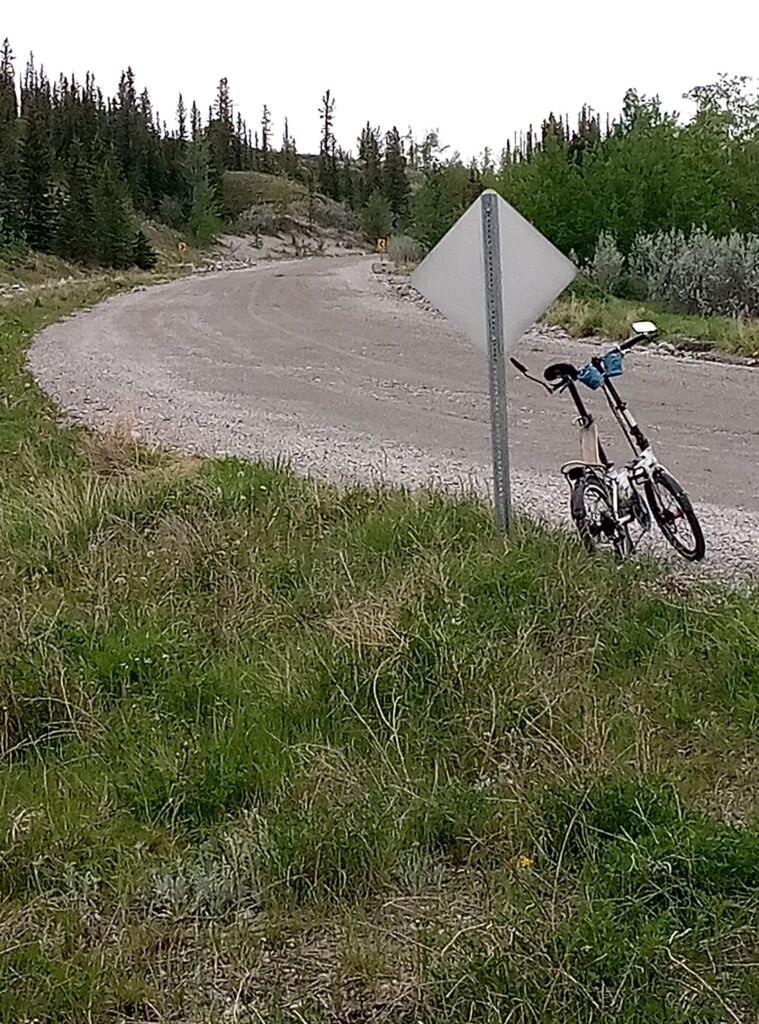
The final hill to reach the river below the Big Horn Dam. This could have been a trip-ender. Once I started down the hill with the three hundred pound (140 kg) loaded canoe in tow, I realized how precarious it was. All the braking comes from the bike only, and on a gravel road, it is my weight that provides braking traction to the wheels. I can stop, but if I was to try to dismount, the canoe would quickly start to roll and overrun the bike. I could also lose traction, on the rear wheel, if the gravel became too loose. Once I started down, I had no choice but to brake as much as possible and try to avoid any loose gravel patches – great potential for a runaway train wreck. Hindsight says cut a small tree and tie it to the stern to act as a drag, as I did when I came down ‘the Hill’ into Bella Coola.
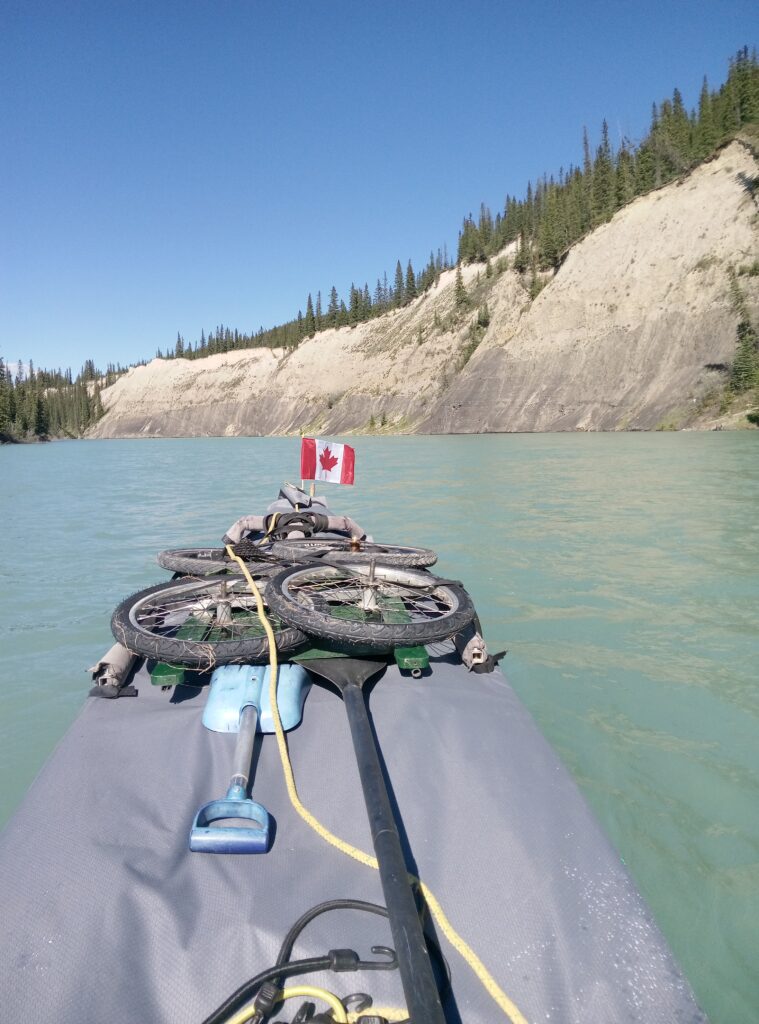
A beauty of a day to start my 1355-kilometre paddle down the North Saskatchewan. The river is high and running fast, and the wind is blowing stronger than I prefer. Two good reasons to say I should stop and camp at the first decent spot to wait for better conditions. Another potential trip-ender was about to happen.
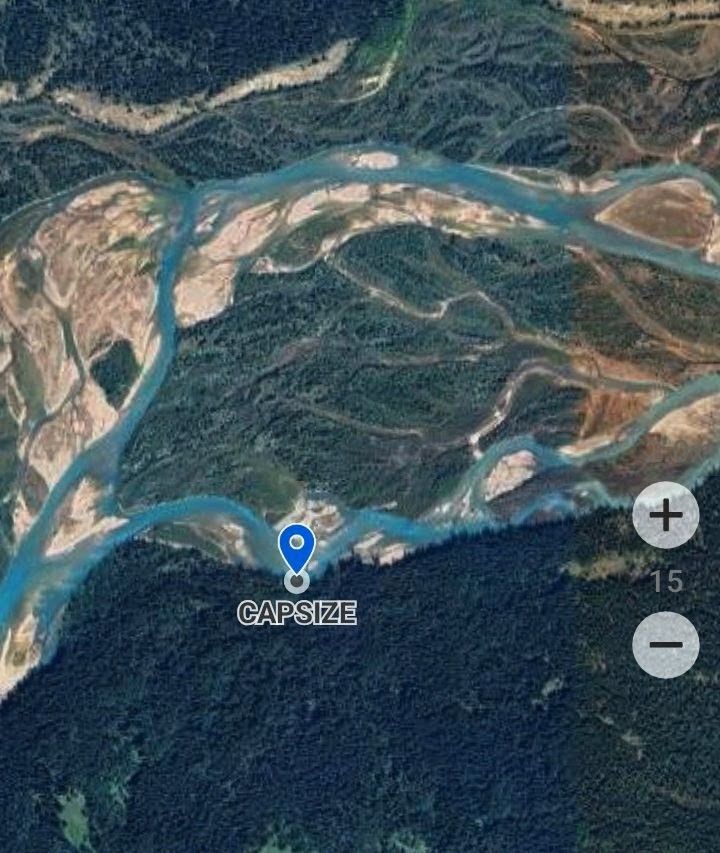
About two hours downstream, I picked the wrong channel, brushed against a sweeper and capsized! (A sweeper being a fallen tree extending into the flow, still attached to the bank.) In fast water, anything that holds the canoe even slightly crossways to the flow is going to cause the canoe to roll. It happens very quickly. I was dumped into the river. As I submerged, I said to myself calmly, ‘this could be it’. I felt a branch and held on as I surfaced. I glanced downstream and watched as the canoe floated away upside down. A very brief thought questioned whether I should swim after it, but ‘save yourself first’ quickly overrode that. Using my knees and what I could grab, it was easy enough to pull myself up onto the bank. I liken my time in the water to being at the edge of a swimming pool, next to the ladder, and rolling into the water, but quickly grabbing the ladder and climbing out. I looked downstream and was surprised to see the canoe, upside down, lodged on a submerged gravel bar. I was hopeful that I might be able to wade out to it and broke some sticks to brace myself against the current for that attempt. The water was too deep though, and I did have another alternative. I was wearing my drysuit, and fortunately I had my personal locator beacon in the breast pocket. I had no other choice. I was on the other side of the river from the highway and didn’t know where the nearest bridge was. I thought it might mean walking all the way back to the dam.
I was expecting that my rescue would be by helicopter and I would be transported far from the canoe. That I would be arranging its salvage by phone. I walked upstream and was able to cross to a small island that had potential for a helicopter to land. Within two hours though, I heard the roar of an approaching jet boat. The Rocky Mountain House Clearwater Fire and Rescue, manned by a crew of about five. As I stepped into the boat, a young lady asked how I was feeling. Like an AH for getting you guys out here, I replied. She grinned and said, ‘First trip on the water this summer, and we’re lovin it!’ I told them that the way the canoe was spray-skirted and even partitioned at its midpoint, I expected that very little of my gear had been lost. I added that I would be happy to make a thousand-dollar donation to their cause if it could be salvaged. I didn’t mean that as a bribe, and I doubt that it influenced their actions. It was required that first they take me back to the Nordegg Bridge where the rest of the rescue team was waiting. At least eight people were there, including two ambulance attendants and an RCMP officer who got them all there with sirens full-on, no doubt. I was feeling pretty small being the cause of all this attention, but the talk was soon enough that they were all delighted that I was unharmed. Even some praise for my being prepared.
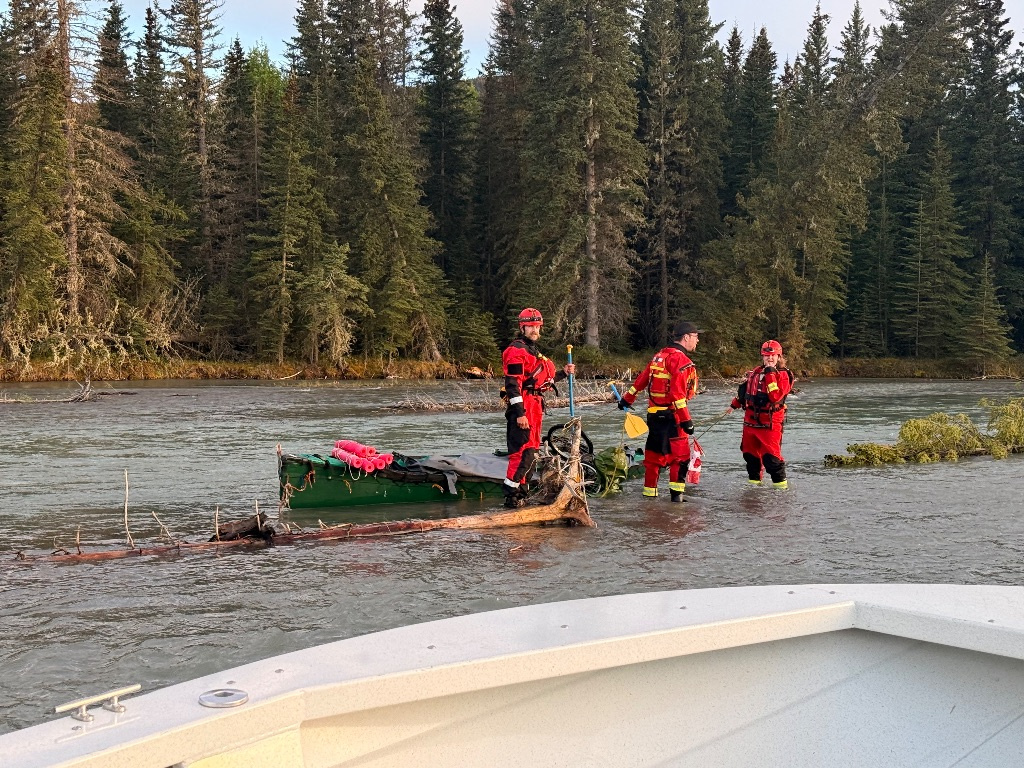
It’s the only picture the rescue crew was able to provide of the canoe’s recovery. After dropping me off, they headed back upstream and returned in a little over an hour with everything except what I had loose, not tied, in the stern or on deck. Gone was my carbon fibre outrigger paddle, a can of bear spray, a waterproof point-and-shoot camera, and the towbar used to attach the canoe to the bicycle. Fortunately, my kayak paddle was lodged up against some debris separate from the canoe, and they were able to retrieve it as well.
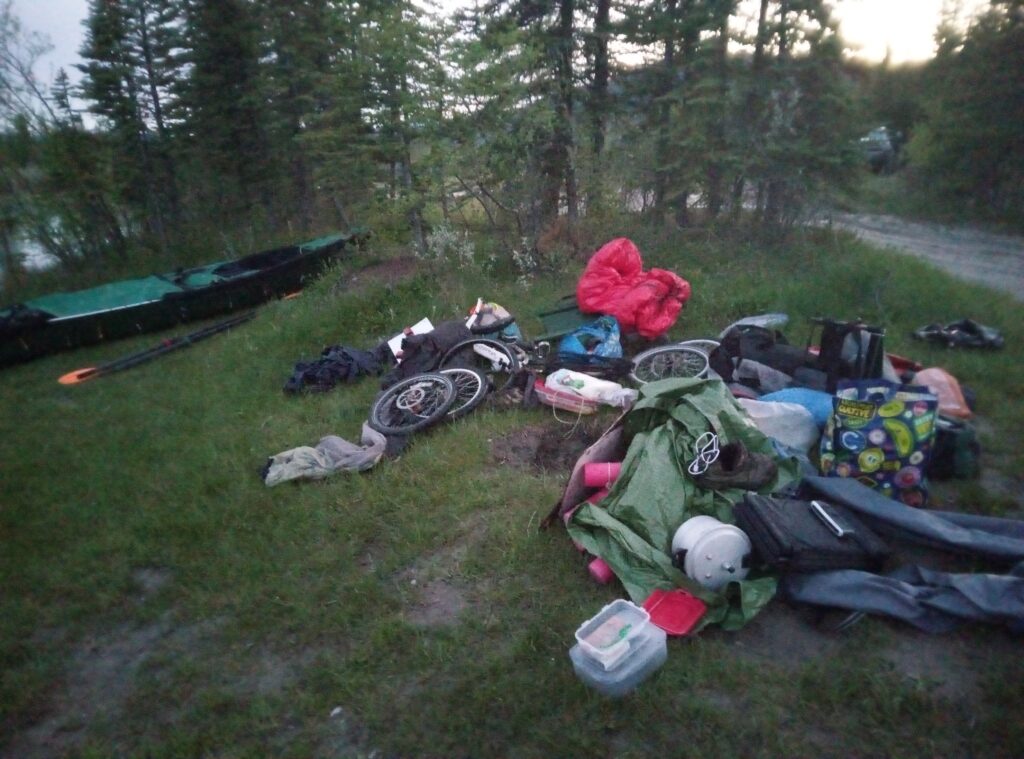
Everything recovered in one big soggy pile. It was remarkable too that the water damage was minimal. My Chromebook and guitar tuner didn’t like their bath, but a two-gallon pail of porridge mix stayed dry. My ten-year-old Garmin Map78 is supposed to withstand submersion for only thirty minutes, but it survived three hours underwater. Same for my Spot Trace, which I use as a personal tracker. It was only stuffed between the folds of my paddle float, which I tie to the spray skirt in front of the cockpit. It should have been washed away or even lost when they picked up the paddle float because it wasn’t attached. Not only did it survive being submerged it got right to work on the trip back downriver and recorded the rescue boats route. My phone also survived. It was in a small, snap-lid, food container that I had velcroed to the bottom of the canoe. I wasn’t expecting to see it again, thinking that the current would have washed it loose. The first thing the crew handed me was my still turned on phone. Also in the phone case were my debit and credit cards. Hindsight says they should have been in my pocket with the PLB. My clothes in a dry bag stayed completely dry but my down sleeping bag in its stuff sack became somewhat soggy. Wearing double layers of the dry clothes, I spent an OK night with the sleeping bag used like a top blanket.
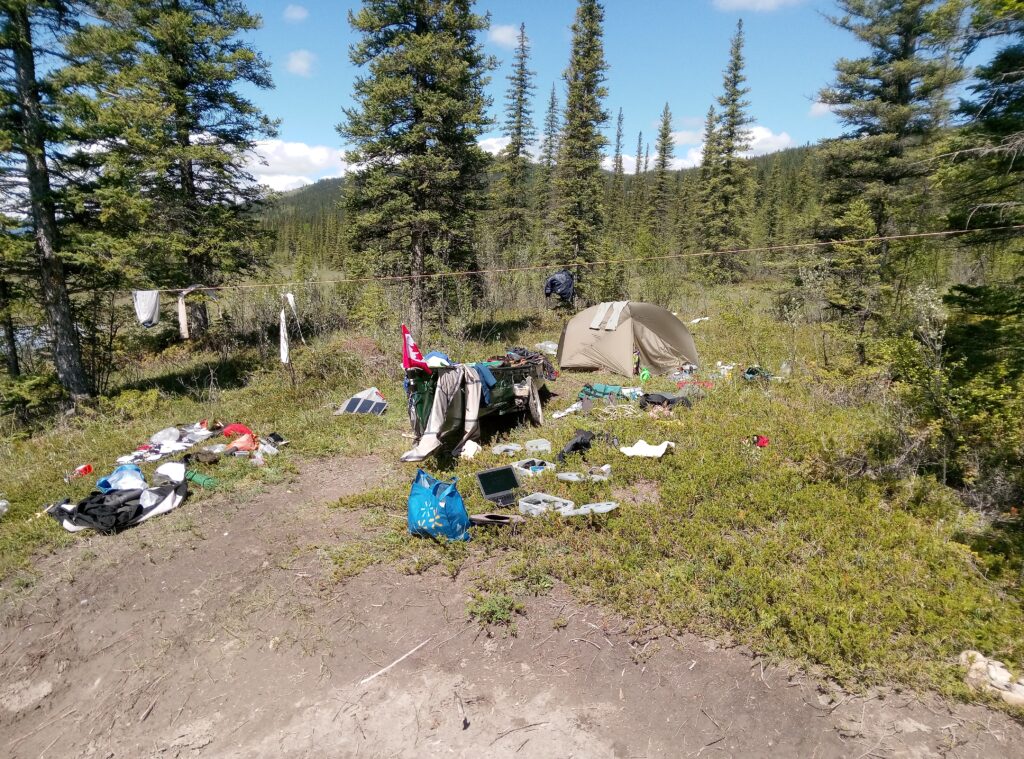
Everything hung out to dry the following day. Lucky for me the sun co-operated. My sleeping bag was usable again that night.
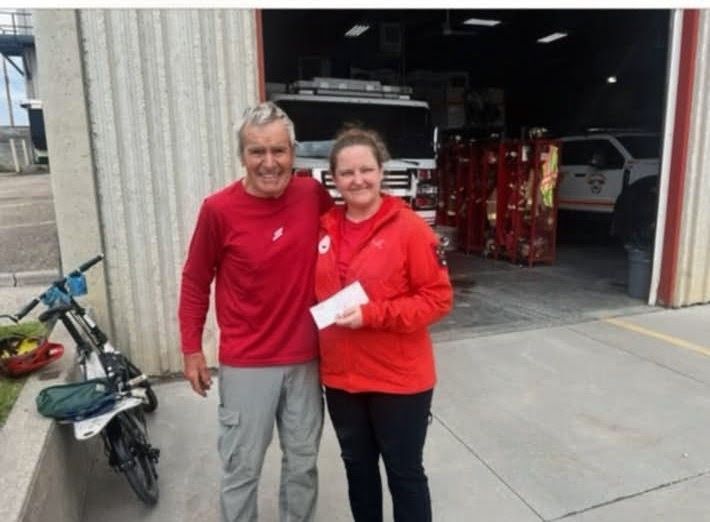
Following through on my commitment to donate $1000 to Clearwater Fire and Rescue. I am very grateful that they took on the recovery of all my gear so willingly.
Kudos, too to Mandy Harris, my New Zealand trapping coordinator, hostess and dear friend. A few years back, as a reward for my trapping efforts, she had the workgroup ok the purchase of my PLB. I have a 2013 InReach satellite communicator with an SOS button, but it would not have been in my pocket because it was too big and not 100% waterproof. I had never given any thought to buying a PLB. I think they cost near $400. Thank-you Mandy!
A video so you too can experience a capsize. This short clip from YouTube took place at Saunders Ledge on the North Saskatchewan. Tom Hudson, who calls his channel ‘What in the World’, was, at the time (2023), an admitted totally inexperienced newbie paddler who set out to paddle from Saskatchewan River Crossing to Montreal. Just recently (2026), he completed his journey. Unlike me, he lost everything except his canoe, which was eventually recovered but needed repairs. The ledge can easily be missed entirely by keeping to the right, which is what I did. Had he hit the wave more perpendicular, his canoe would have easily passed over it. My capsize wasn’t as fast as this but once it starts tipping there’s nothing can be done to stop it.
Saying that, I recall my 2013 encounter with a sweeper on the Columbia River. I managed to escape from that one but only by the very narrowest of margins. I will paste in what I wrote about that episode. (It can be found under the 2013 menu heading ‘Paddle Invermere to Kinbasket Lake’)
The next morning I made the short run downstream to this creek. Bluewater creek would be running very fast and although I expected there should be a good back-eddy (as there usually is) at the upstream side of the junction I thought it best to have a look before entering the mouth of the creek. I pulled the canoe to the shore where the current was slower, wanting to find a place where I could at least tie the canoe while I inspected the creek. I did manage to stop the canoe and hang onto some vegetation but then decided that some overhanging tree branches just downstream a couple of boat lengths offered a better spot. This was a big mistake that almost had me in the water with the boat capsized. I know well that any ‘sweepers’ are deadly to a canoe. Those being any overhanging obstacle that could block the free flow of the boat. When this happens, with the boat parallel to the obstruction, the top of the boat is held stationary while the current continues to push against the bottom. The result is the boat tips, and it is not possible to hold the boat to prevent it from tipping. I didn’t see these branches as being such an obstacle though. They weren’t touching the water and they didn’t look strong enough to hold back the canoe. I also had expected that I’d be able to keep the canoe from swinging parallel to them. Right away though, as I started to drift towards them, the boat did swing parallel and I was in a struggle to prevent the boat from capsizing, as the canoe came up against the branches. My first action was to try to pull away from the shore into open water. This attempt only lasted a fraction of a minute but at one point the boat was tipped so much that the water was right up to the spray skirt covered gunnel. Very trying moments, trying to hold the canoe from tipping more, while seeing it tipped so much that without the spray skirt water would have been flooding over the gunnels. At one point I let go of the kayak paddle and was lucky to be able to grab it again before it was out of reach. I thought I was not going to be able to prevent a capsize. Then I quickly changed my tactic to one of pushing up on the branches and this worked. I was forced under them and the canoe was free again. This had me at the mouth of the fast-flowing creek and the expected back-eddy that allowed me to easily paddle to shore. That was a very close call. If I had capsized I’m confident that I would have had no problem getting myself ashore. But I doubt that I would have been able to prevent the canoe from going down the canyon and had that happened I don’t expect I would have ever seen any of it again. As it was the only loss was my hat! The gain was the knowledge of never making that same stupid mistake again. I refer to my close calls with a one to ten rating of what I call my ‘degree of concern’. This episode at Bluewater Creek ranks as the highest for my entire journey, a 9 out of 10.
I would still rate that 2013 sweeper incident to be more concerning than my actual capsize. That because of the time spent struggling against the force of the river. As I mentioned, with the actual capsize there was no contest, I was in and out of the water before I had time to be overly concerned.